
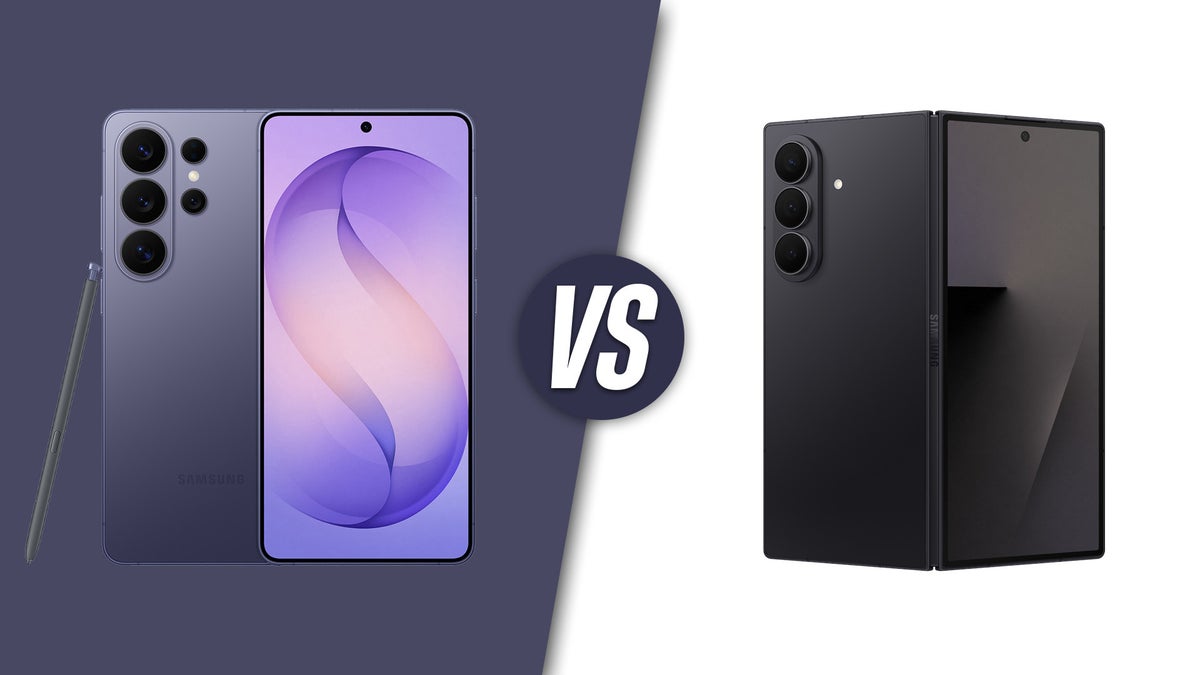
Galaxy S26 Ultra vs Galaxy Z Fold 7 differences:
| Galaxy S26 Ultra | Galaxy Z Fold 7 |
|---|---|
| Snapdragon 8 Elite Gen 5 for Galaxy (all regions) | Snapdragon 8 Elite for Galaxy |
| 6.9″ Dynamic AMOLED 2X, up to 2,600 nits | Cover: 6.5″ Dynamic AMOLED 2X, up to 2,600 nits Main: 8″ Dynamic AMOLED 2X, up to 2,600 nits |
| Gorilla Armor 2 | Cover: Gorilla Glass Ceramic 2 Main: Soft, flexible OLED |
| Built-in Privacy Display mode | No Privacy Display mode |
| 200 MP wide with updated optics | 200 MP wide |
| 50 MP 5x with f/2.9 aperture | 10MP 3x with f/2.4 aperture |
| Up to 60W (Super Fast Charging 3.0) | 25W |
| Up to 25W (Super Fast Wireless Charging) | 15W |
| 7.9 mm, 214 g | 8.9 mm folded, 215 g |
| Aluminum frame | Aluminum frame |
Table of Contents:
Design and Size
The light notepad or the massive screen?
These are both pretty huge phones, ones that we used to call “phablets”. Technically, the Z Fold 7 is much closer to such a description due to its… you know — semi-tablet-sized main screen.
But, when it’s closed, it’s about as thin as the Galaxy S26 Ultra, and not any heavier, too!
You will also notice that their design language is very similar, with their main camera modules housed on a camera island now. Apparently, this is the new Samsung design language, at least for the time being.
But there’s no going around this — these are very different types of phones. One 6.9-inch chocobar with an S Pen. The other unfolds to give you a square-ish 8-inch screen, which may not be amazing Netflix binging, but super-powers multi-tasking.
Still, the Z Fold 7 can easily be a chocobar phone. Last year, Samsung made great strides towards thinning its foldable out and making the external screen bigger. Unfortunately, the S Pen fell victim during the efforts. No, you can’t even buy one separately and use it — the Z Fold 7 does not have a stylus digitizer under its screen.
| Galaxy S26 Ultra | Galaxy Z Fold 7 |
|---|---|
| Thickness 7.9 mm |
Thickness 8.9 mm folded |
| Dimensions Around 163.6 x 78.1 mm |
Dimensions 72.8 x 158.4 x 8.9 mm folded |
| Weight 214 grams |
Weight 215 grams |
Display Differences
The galaxy S26 Ultra did not come with upgrades to peak brightness — something we’ve learned to expect year over year. In fairness, 2,600 nits peak is still plenty bright. And it’s assisted by the excellent anti-glare properties of the Gorilla Armor glass on the S26 Ultra.
| Galaxy S26 Ultra | Galaxy Z Fold 7 |
|---|---|
| Size 6.9″ |
Size 6.5″ cover 8″ main |
| Brightness 2600 nits (peak) |
Brightness 2600 nits (peak) |
The Z Fold 7 also hits 2,600 nits peak and has been looking pretty striking over the past few months. Unfortunately, it doesn’t get the anti-glare treatment.
The Galaxy S26 Ultra does have a new feature around its display, though — Privacy Display. When enabled, it narrows side viewing angles so the screen is harder to read from the side. It kind of works like a privacy screen protector… just one that you can toggle. And actually looks better.
You also don’t need to cast the shade over your entire screen — it can be set up to hide notifications, PIN input, or just specific apps like the one you use for banking.
Performance and Software
New Snapdragon, new heat management
The S26 Ultra comes with the all-new Qualcomm Snapdragon 8 Elite Gen 5, of course with the “for Galaxy” moniker to show that it has been slightly overclocked.
Performance-wise, Samsung says the S26 Ultra has a 19% faster CPU, a 24% stronger GPU, and a 39% improved NPU compared to the Snapdragon 8 Elite for Galaxy in the Z Fold 7. Clearly, the focus was on improving the performance of AI-related functions.
| Galaxy S26 Ultra | Galaxy Z Fold 7 |
|---|---|
| Chip Qualcomm Snapdragon 8 Elite Gen 5 (for Galaxy) |
Chip Qualcomm Snapdragon 8 Elite (for Galaxy) |
| Process 3nm |
Process 3nm |
| RAM, Storage 12/256 GB 12/512 GB 16/1 TB LPDDR5X RAM |
RAM, Storage 12/256 GB 12/512 GB 16/1 TB LPDDR5X RAM |
There is also a redesigned vapor chamber and other small improvements to help the S26 Ultra maintain peak performance levels for longer. The Galaxy Z Fold 7 does not have a vapor cooling chamber, but does use a graphite sheet, which is still effective and helps slim the device down. Still, we expect more sustained performance from the S26 Ultra. Benchmarks below.
CPU Performance Benchmarks:
GPU Performance:
Perfect improvement across the board. To be fair, the Z Fold 7 is still no slouch, but the Galaxy S26 Ultra performance is definitely that “next level”.
But the Z Fold 7 should be getting an update, hopefully soon. It’ll have all the new AI tricks, including the “Now Nudge” which will use on-device AI to ensure you don’t forget about things that you’ve agreed upon in conversations or other on-screen content. Creepy? Naaaah.
Camera
Still 200 MP, but with new optics
The S26 Ultra’s cameras don’t sound new on paper: 200 MP main camera, 50 MP ultrawide, 10 MP 3x telephoto and a 50 MP 5x telephoto.
But the 5x telephoto and main cameras now come with new lenses with wider apertures that capture more light. This should reduce blurry photos further, and improve low light performance yet again.
| Galaxy S26 Ultra | Galaxy Z Fold 7 |
|---|---|
| Main 200 MP, f/1.4 24 mm 1/1.3″ sensor size |
Main 200 MP, f/1.7 24 mm 1/1.3″ sensor size |
| Ultrawide 50 MP, f/1.9 13 mm 1/2.5″ sensor size |
Ultrawide 12 MP, f/2.2 13 mm 1/2.55″ sensor size |
| 5x Telephoto 50 MP, f/2.9 5X zoom (111mm) 1/2.52″ sensor size |
3x Telephoto 10 MP, f/2.4 3X zoom (67 mm) 1/3.94″ sensor size |
| 3x Telephoto 10 MP, f/2.4 3x zoom (67mm) 1/3.94″ sensor size |
— |
And yes, the Z Fold’s lone telephoto camera has a wider aperture, but that’s because aperture size can be bigger when the lens provides less zoom. Which is the case here.
Samsung is now focusing on video, though, with 8K 30 FPS available on the Galaxy S26 Ultra. We also get 4K at 120 FPS, which will mean super-sharp slow-mo videos!
It also introduces support for APV, which stands for Advanced Professional Video. APV is a new high-quality video format designed to preserve more detail, dynamic range, and color information during recording, giving users more control during their workflow.
So the galaxy Z Fold 7 is back to the “is this a compromise?” bench. Yes, you get that big screen, but if you are more invested in photo and video, it seems the Galaxy s26 Ultra is the Samsung camera flagship.
Battery Life and Charging
Faster charging is here
We are still stuck at a 5,000 mAh barrier with the Samsung flagships. No magnets on the back, so no full Qi2 support, too (unless you add a case).
Wireless charging also takes a major step forward to up to 25W thanks to Qi2.2. Technically, the S26 Ultra doesn’t cover the full standard due to the lack of magnets, but it does adhere to the charging protocols.
The Galaxy Z Fold 7 takes it easy with the charging speeds. Very easy — limited to 25 W wired. Possibly just to be on the safe side with that thin, thin body.
| Galaxy S26 Ultra | Galaxy Z Fold 7 |
|---|---|
| Battery size 5,000 mAh |
Battery size 4,400 mAh |
|
Charging speeds 25W wireless charging USB-C 3.2 |
Charging speeds 25W wired 15W wireless charging USB-C 3.2 |
Specs Comparison
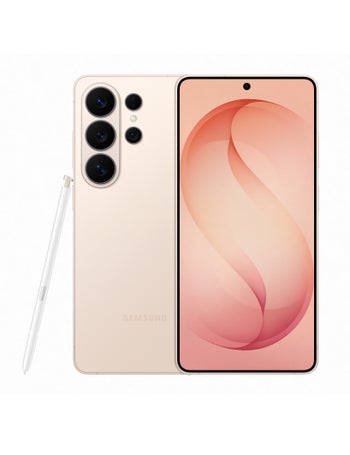
|
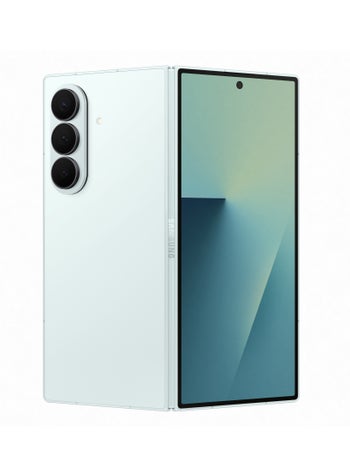
|
| Samsung Galaxy S26 Ultra | Samsung Galaxy Z Fold 7 |
| Dimensions | |
|---|---|
| 163.6 x 78.1 x 7.9 mm (~10 mm with camera bump) | 158.4 x 143.2 x 4.2 mm (~8.6 mm with camera bump) |
| Weight | |
| 214.0 g | 215.0 g |
| Size | |
|---|---|
| 6.9-inch | 8.0-inch |
| Type | |
| Dynamic AMOLED, 120Hz | Dynamic AMOLED, 120Hz |
| System chip | |
|---|---|
| Snapdragon 8 Elite Gen 5 SM8850-AC (3 nm) | Snapdragon 8 Elite for Galaxy SM8750-AB (3 nm) |
| Memory | |
| 12GB (LPDDR5X)/256GB (UFS 4.0) 12GB/512GB 16GB/1024GB |
12GB (LPDDR5X)/256GB (UFS 4.0) 12GB/512GB 16GB/512GB |
| Type | |
|---|---|
| 5000 mAh | 4400 mAh |
| Charge speed | |
| Wired: 45.0W Wireless: 15.0W |
Wired: 25.0W Wireless: 15.0W |
| Main camera | |
|---|---|
| 200 MP (OIS, PDAF) Sensor name: Samsung ISOCELL HP2 Aperture size: F1.4 Focal length: 23 mm Sensor size: 1/1.3″ Pixel size: 0.6 μm |
200 MP (OIS, PDAF) Aperture size: F1.7 Focal length: 24 mm Sensor size: 1/1.3″ Pixel size: 0.6 μm |
| Second camera | |
| 50 MP (Ultra-wide, PDAF) Sensor name: Samsung JN3 Aperture size: F1.9 Sensor size: 1/2.5″ Pixel size: 0.7 μm |
12 MP (Ultra-wide) Aperture size: F2.2 Pixel size: 1.4 μm |
| Third camera | |
| 10 MP (Telephoto, OIS, PDAF) Sensor name: Sony IMX754 Optical zoom: 3.0x Aperture size: F2.4 Sensor size: 1/3.94″ Pixel size: 1.12 μm |
10 MP (Telephoto, OIS, PDAF) Optical zoom: 3.0x Aperture size: F2.4 Focal Length: 67 mm Pixel size: 1.0 μm |
| Fourth camera | |
| 50 MP (Telephoto, Periscope, OIS, PDAF) Sensor name: Sony IMX854 Optical zoom: 5.0x Aperture size: F2.9 Focal Length: 115 mm Sensor size: 1/2.52″ Pixel size: 0.7 μm |
|
| Front | |
| 12 MP (PDAF, HDR) | 10 MP (HDR) |
Samsung Galaxy S26 Ultra vs Samsung Galaxy Z Fold 7 specs comparison
or compare them to other phones using our
Phone Comparison tool
Summary
It’s a tough call, really. Both of these phones are true gems of Samsung engineering. The main question is — do you want the camera upgrades or do you want a big screen to hover multiple apps on?
Then, we have performance. While the 8-inch main display on a Galaxy Z Fold 7 is great for gaming or video editing, it’s hard to imagine the Galaxy S26 Ultra won’t just be better at it. Plus, it has the better cooling.
More tests to come and final opinion yet to be formed. What are you thinking so far?
👇Follow more 👇
👉 bdphone.com
👉 ultractivation.com
👉 trainingreferral.com
👉 shaplafood.com
👉 bangladeshi.help
👉 www.forexdhaka.com
👉 uncommunication.com
👉 ultra-sim.com
👉 forexdhaka.com
👉 ultrafxfund.com
👉 bdphoneonline.com
👉 dailyadvice.us